

How To Check Local User Creation Date In Windows Server
-
How to utilise ADAudit Plus to cheque out who created a local user account.
-
Navigate to'Server Inspect' Tab.
-
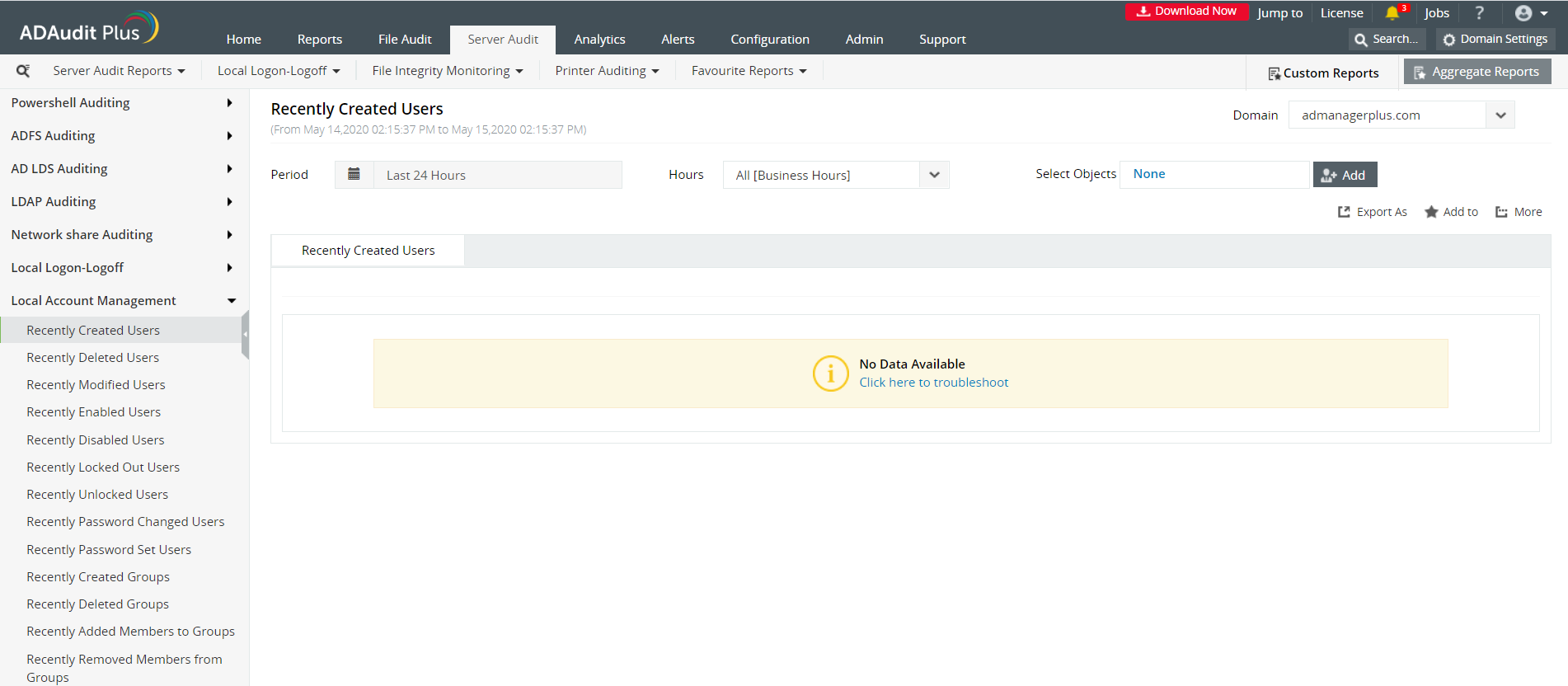
Since you're looking for local user account creations, cull the 'Local Business relationship Direction' tab Yous can and then navigate to the pre-configured study named 'Recently Created Users'.
-
This gives you a report of newly created local user accounts. You tin check who created a local user account here.
-
Customize the Period to desired time range. You can also ascertain a custom menstruum and save for quick reference.
-
A detailed audit information study is generated for the selected flow.
-
Clicking on an event in the bar graph, filters the written report view highlighting only the selected event.
-
Advanced filter options help you locate the specific event that you're looking for.
-
Annotation: To enable the required auditing, please refer to Footstep 1 on the Native Ad Auditing tab. Later this you can follow the steps below to view the relevant events.
-
Pace i: Enable Group Policy Auditing
-
Launch theServer Director and open the Grouping Policy Management Panel (GPMC).
-
In the left pane, expand theWood and Domains nodes to reveal the specified domain y'all want to track the changes for.
-
Aggrandize the domain and right-click Default Domain Policy. You can also choose a domain policy that is universal throughout the domain, or create a new GPO and link it to the Default Domain Policy.
-
Click on Edit of the desired group policy, to open up the Grouping Policy Management Editor.
-
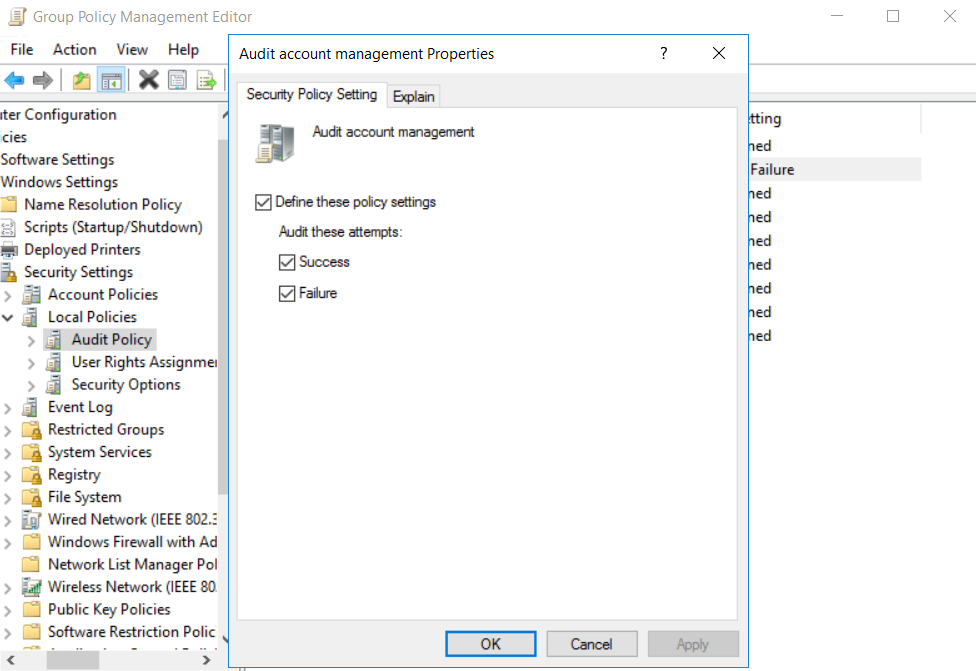
Expand 'Computer Configuration'-->Policies-->Windows Settings-->Security Settings-->Local Policies-->Audit Policies.
-
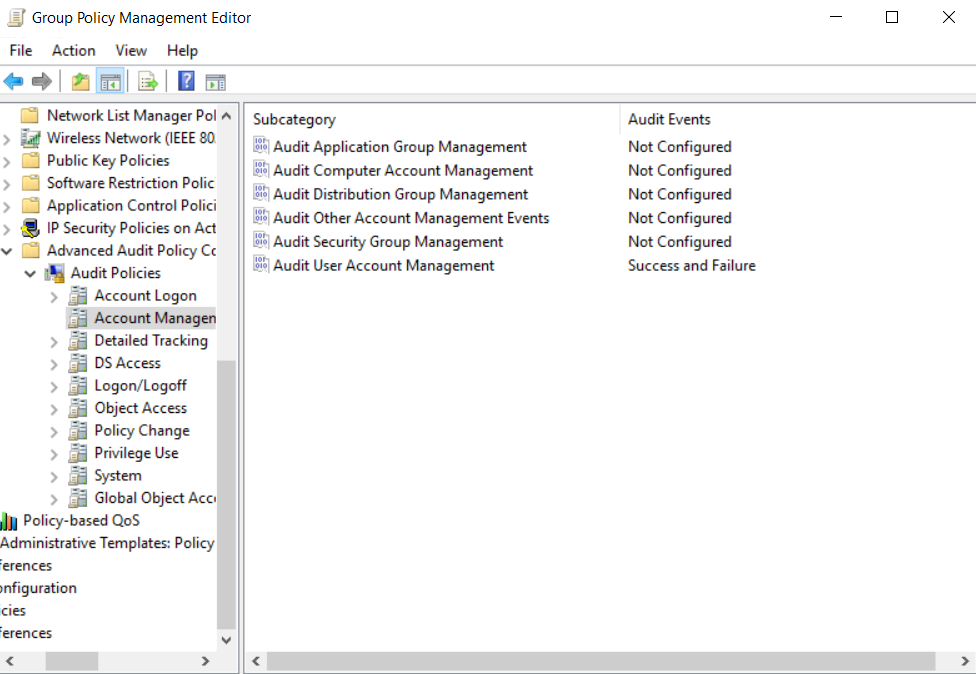
Enable success and failure options for 'Inspect account management'. also allow for more granular auditing. Select the 'Advanced Audit Policy'-->'Audit Policy'-->Account Direction-->Inspect User Account Direction. Get out Group Policy Direction Editor.
-
In the GPMC, choose the modified GPO, and click 'Add together' in the 'Security' department on the right pane. Type 'everyone' in the text box and click 'Check Names' to "to track the changes fabricated by anybody who has logged into the domain." or something similar would piece of work.. Exit the GPMC.
- To enforce these changes throughout the domain, run the command 'gpupdate /force', in the "Run" panel.
-
Step 2: Allow Ad Auditing through ADSI Edit
-
From your 'Server Manager' go to 'Tools'and select 'ADSI Edit'.
-
Correct click 'ADSI Edit' node from the left pane and select 'Connect to' option. This pulls upwardly the 'Connection Settings'window.
-
Select the Default Naming Context' option from the 'Select a well-known Naming Context' drop down list.
-
Click 'Okay'and return to the ADSI Edit window. Expand 'Default Naming Context'and select the associated 'DC' subnode. Right-click this subnode and click 'Backdrop'.
-
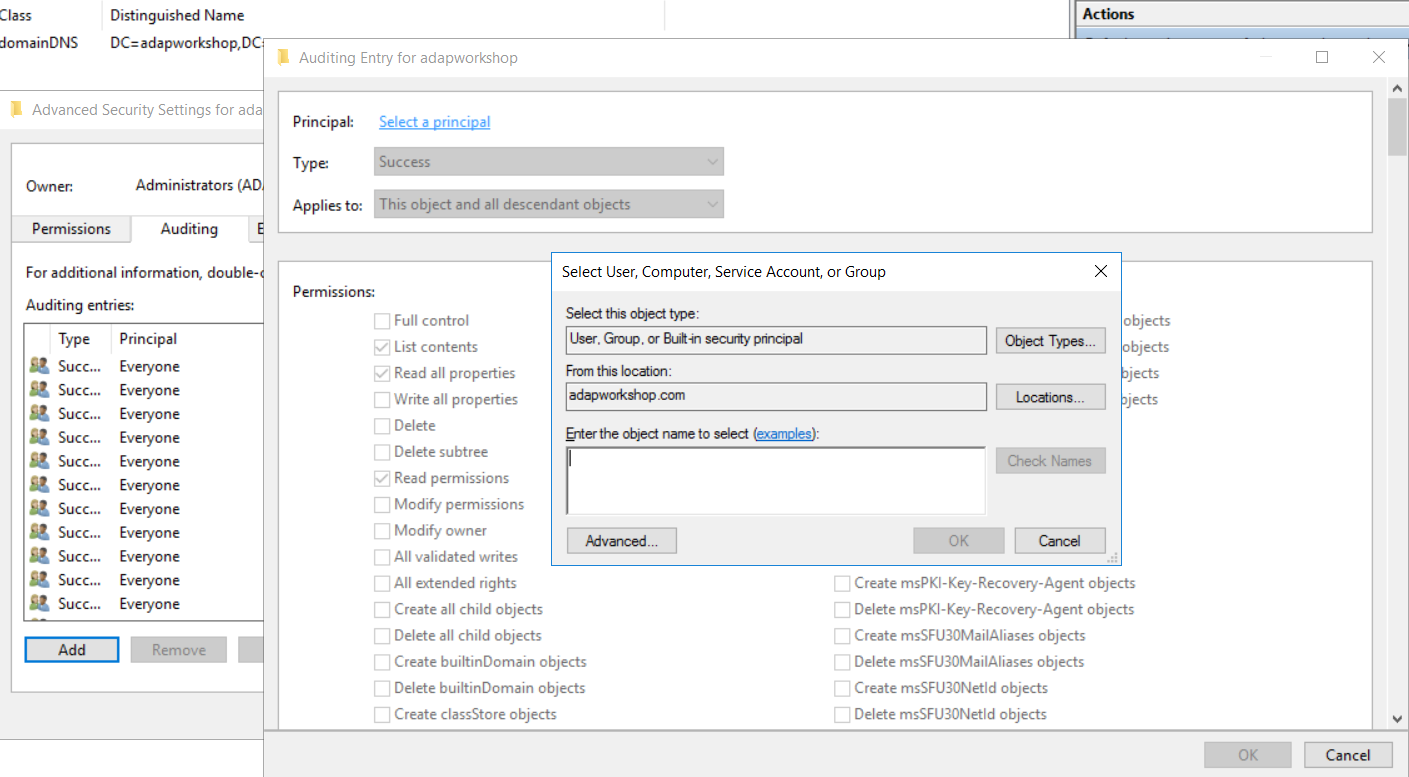
In the 'Properties'window, go to the 'Security' tab and select 'Advanced'.After that select 'Auditing'tab and click 'Add'.
-
Click on ' Select a master'.This will bring up a 'Select User, Estimator or Group'Window. Blazon 'Everyone' in the textbox and verify information technology with 'Check Names'.
-
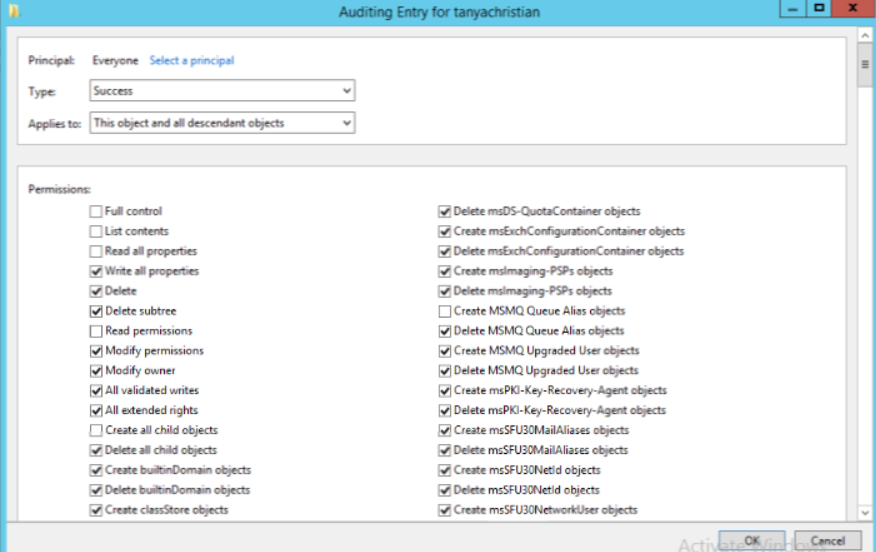
The 'Master'in the 'Auditing Entry'window at present shows 'Everyone'. In the 'Type' drop-downward select 'All'to audit for both 'success' and 'failure'events.
-
In the 'Select' drop-down choose 'This object and all descendant object's. Select 'Full Control' in the 'Permissions' section.
-
This selects all the checkboxes available. Unselect the following check boxes:
- Total Control
- List Contents
- Read all backdrop
- Read permissions
-
Stride 3: Viewing Events in Result Viewer
-
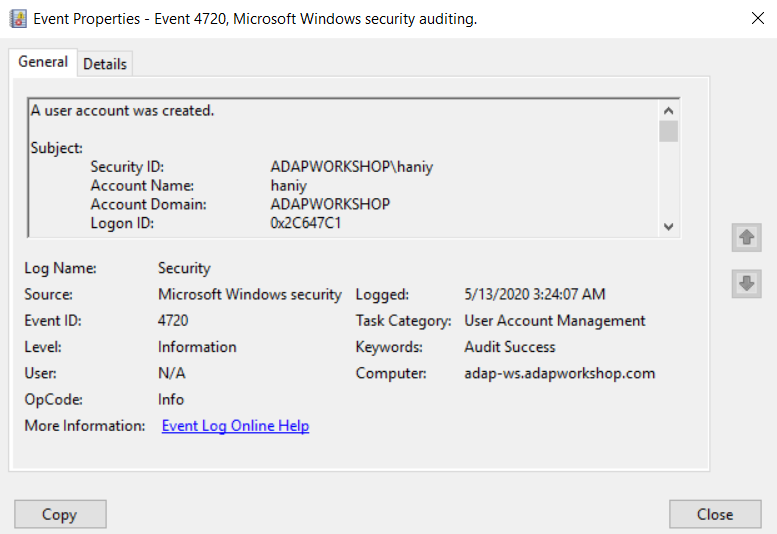
You can view events of any new user accounts created in Event Viewer. Filter the log to view the following event.
Event ID 4720 describes a user account that is created.
You tin can check out the details of who created the local user account in the Result Properties. If the user account is a local user account, and then the 'Account Domain' field will incorporate the device proper name on which it was created.
Active Directory Auditing just got easier!
ADAudit Plus comes bundled with more than 300 predefined reports that makes your Advertizement auditing easier. The solution too sends real-fourth dimension alerts for disquisitional events and thereby help you to secure your network from threats and boost your IT security posture. Check out the capabilities of ADAudit Plus here.
Download ADAudit Plus
Source: https://www.manageengine.com/products/active-directory-audit/how-to/find-out-who-created-local-user-account.html
Posted by: stewarttorcer.blogspot.com
0 Response to "How To Check Local User Creation Date In Windows Server"
Post a Comment